Constance Frederica Gordon-Cumming
- Years
- –
- Available items
- 2
- Sold items
- 1
Biography
Show more Show less
Click here for the latest catalogue
Gordon-Cumming’s extensive publications and her participation in important exhibitions meant she was well known to her contemporaries but in the century since her death, she has largely faded from view, mainly because her work has rarely been shown, as it has remained in the hands of her descendants.
The artist, known as Eka, was the twelfth child of Sir William Gordon-Cumming, 2nd Baronet of Altyre and Gordonstoun and his first wife Eliza Campbell and born at the family seat of Altyre, Morayshire, on the river Findhorn in the Scottish Highlands.
As was normal at that time, Gordon-Cumming was educated at home, presumably by governesses or tutors. Eka was brought up in an artistic environment, as her mother painted in both oils and watercolours, and her siblings also drew. Her mother was also a palaeontologist who died in 1842. From 1848 to 1853 Eka went to Hermitage Lodge in Fulham, a school run by the three Stevens sisters. In 1854 she did the London season.
The artist spent her summer holidays at the Gordon-Cumming home at Altyre, sketching, fishing (comparatively unusual for women in Victorian England), walking and climbing and visiting Gordonstoun. She developed an adventurous temperament and love of mountaineering.
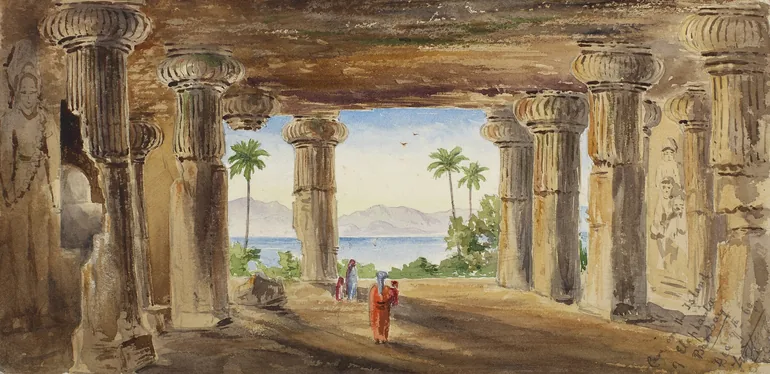
Gordon-Cumming pursued her artistic development in the 1860s exhibiting in Edinburgh and Glasgow from 1866 and 1867 respectively. Gregarious and sociable, she stayed with friends and relations, always sketching and painting in watercolours as she went. In 1868 she made her first painting tour of the Western Isles. In November 1868 the artist travelled to India, at the invitation of her half-sister Emilia and her husband Warden Sergison, formerly of the 4th Hussars. She returned to the United Kingdom in February 1870, with many watercolours and drawings, when her first article ‘Camp Life in the Himalayas’ was published in Good Words. She wrote more about her travels in From the Hebrides to the Himalayas in 1876. Henceforth, inspired by her first long journey, painting, writing and travel became her way of life.
Gordon-Cumming drew and painted watercolours extensively while she travelled.
She rose around 4 or 5 a.m., working very fast to produce accurate pencil sketches, which she would subsequently touch in with watercolour. In addition to small sketchbooks and larger blocks of paper, she travelled with a very large zinc block contained in a large tin box. This enabled her to compose larger compositions unconstrained by the risks of accidental damage (Memories, pp. 199-200).
She returned to Ceylon from 1872 to July 1874, describing in her autobiography how ‘I proved, as I have often done before, how soothing are long days of solitary sketching, alone with beautiful nature’, Memories, p. 211. She returned with several hundred paintings ‘of exceeding interest’ which were exhibited in London, Glasgow and elsewhere.
Two Happy Years in Ceylon was published in 1892 and was well received. In 1874 Rachel Hamilton Gordon invited the artist to accompany her and her husband Sir Arthur Gordon, to Fiji, following his appointment as the first British Governor of Fii. The party left England in March 1875 stopping at Singapore before arriving in Sydney. The artist spent three months in Australia visiting the Blue Mountains and the Duntroon sheep station. Between September 1875 and March 1878 Gordon-Cumming visited Fiji and New Zealand, and travelled across the South Seas, following a fortuitous encounter with the captain of a French man-of-war, the Seignelay, which enabled her to travel to Tonga, Samoa and Tahiti. The Roman Catholic bishop of Samoa, who was on a cruise around his oceanic diocese, acted as her chaperone. The French officers fitted up a pretty little cabin to accommodate the artist. This trip is recorded in her subsequent
books At Home in Fiji (1881) and A Lady’s Cruise in a FrenchMan-of-War (1882).
The artist then proceeded to California, where she spent several months in the Yosemite Valley. She rode in all directions, glad of the side saddle she had with her, to paint the views from various mountain summits and watched the seasons change from the melting of the snow, when the crags were visible and the trees leafless, to the growth of the vegetation. The Sequoia Gigantea captured her imagination as did the other trees. She organised the first art exhibition in Yosemite to show around fifty of her watercolours and sketches and recorded her time there in Granite Crags (1884).
Gordon-Cumming continued her travels to Japan and arrived in Nagasaki on 6 September 1878. She spent a couple of months in Japan and left from Yokohama for China in December. She travelled through China until June 1879 visiting Hong Kong, Canton,Tsientsin and Peking. There she met a Scottish missionary, William Hill Murray, who had invented the Numeral Type system and was teaching blind Chinese to read and write. Gordon-Cumming became a stalwart supporter of his school and wrote two books about the blind in China, in addition to her publication Wanderings in China (1886).
Gordon-Cumming continued what was to become her longest trip by returning to the United States via Japan, arriving in San Francisco in September 1879. On 1 October she left for Hawaii and spent two months exploring the islands and observing their volcanoes, as recorded in her publication Fire Fountains: The Kingdom of Hawaii
(1873). She then crossed the United States and finally docked in Liverpool on 13 March 1880.
Her home for the next nine years was with Nelly, her now widowed sister, at Crieff, Perthshire, and after Nelly’s death in 1889, she lived there alone. Her most productive period followed, during which she wrote many of her books and articles and continued to paint.
Her autobiography Memories (1904) was her final work. The artist’s work was extensively exhibited in her lifetime. In 1914 Gordon-Cumming’s achievement was recognised when she was made a Life Fellow of the Royal Geographical Society. She died at Crieff on 4 September 1924.
The artist was a landscape painter, an explorer and a mountaineer. Aware of her privileged circumstances she wanted to record the places she visited to share them with others. She was drawn to high peaks and mountains and was able to ride and climb to a level unusual amongst Victorian women. Her interest and aptitude must have started in her childhood in the Highlands of Scotland (views of two Munros, Schihallion, and Ben Lawers are included in this collection). She was to climb in the Himalayas, the tea country in Ceylon where she ascended Adam’s Peak and Mount Pedro, the highest mountain on the island, the Blue Mountains in New South Wales, and the volcanoes of the South Sea islands. Yosemite particularly impressed her as she wrote in Granite Crags, 'Truly these Californian Alps hold treasures of delight for lovers of all beautiful nature, who on their part can bring strength and energy for mountaineering — a sure foot, a steady head and any amount of endurance’.