Emily Farmer
- Years
- –
- Country
- United Kingdom
- Sold items
- 1
Biography
Show more Show less
Emily Farmer exhibited over one hundred works at the New Society of Painters in Water Colours during her lifetime, achieving good notices from contemporary critics, but her work has fallen from public view like that of many other women artists.
She was the daughter of John Biker Farmer who worked for the East India Company and his wife Frances Ann (née Frost). Like many women of her generation Emily was home educated and was taught art by her brother Alexander Farmer, the genre painter.
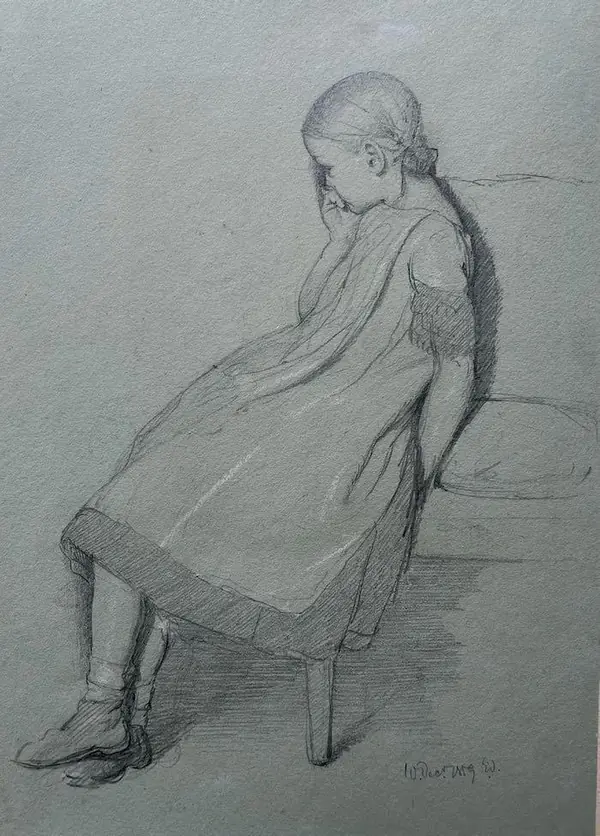
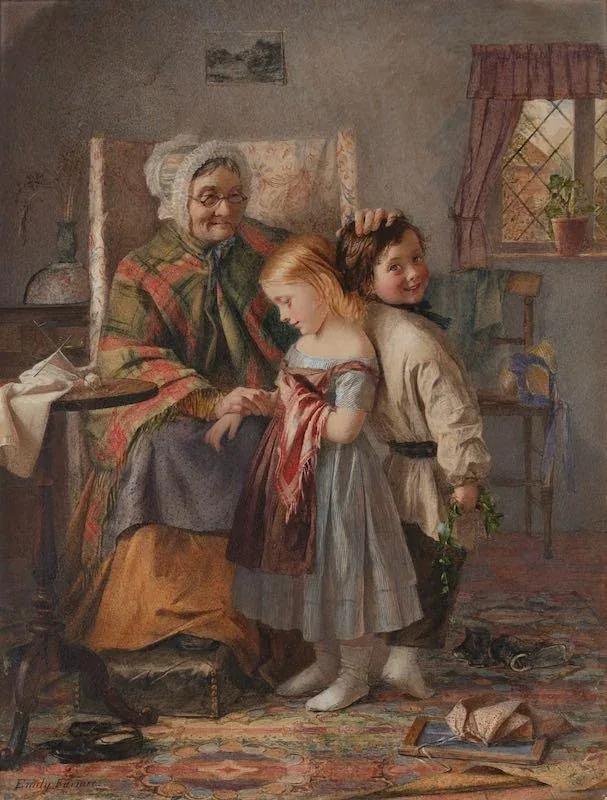
Farmer’s early work was in miniature and she exhibited twice at the Royal Academy in 1847 and 1849 but from 1850 she began to concentrate on genre painting and developed her particular love of painting children.
Farmer was elected to the New Society of Painters in Water Colours in 1854.
Of a membership of fifty-seven artists in 1850 she was the tenth female member of the Society added four years later, the other nine being Fanny and Louisa Corbaux, Jane Egerton, Fanny Harris, Mary Margetts, Mrs William (Emma) Oliver, Sarah Setchell and Fanny Steers. She exhibited nearly one hundred works there, including the present watercolour, over the course of her artistic career.
Pamela Nunn points out that although there was not much women’s work exhibited at the New Society’s exhibitions it was often regarded as the most interesting.1 Farmer was singled out for special mention by contemporary critics:
“...Miss Farmer’s pictures, which are, all things considered, the best figure pieces in the collection. They are true in gesture and expression, conscientious in execution and harmonious in colour”, Spectator, May 3, 1862, p. 495.
“Miss Farmer is the only figure artist (here) whose drawings give any hope or promise”..., ibid, April 28, 1866, p. 467.
“Let us call attention to the two modest bits of Domestic by Miss Farmer, the best of that class in the room”, Critic, April 28, 1860, p. 351.
Farmer also exhibited work at the Royal Scottish Society of Painters in Water Colours and the Liverpool Academy.
Emily Farmer lived for over half a century at Porchester House in Porchester, Hampshire where she died in 1905. She is buried in the churchyard of St Mary’s, Porchester.
Examples of her work can be found in the Victoria and Albert Museum and the National Gallery of Art, Washington D.C.
Roundell Palmer, 1st Earl of Selborne (1812-1895), PC, FRCS, was an English lawyer and politician. He was appointed Solicitor General in Lord Palmerston’s government in 1861 and promoted to Attorney General in 1862.
He handled many questions of international law which arose from the American Civil War including the Alabama Affair and was the leading counsel for Britain before the Alabama Claims tribunal in Geneva. In 1872 he was appointed Lord Chancellor under Gladstone, an office he held again from 1880-1885. He lived at Blackmoor House in Hampshire, built from 1865-1882 to the designs of Alfred Waterhouse. Two chairs and a hanging corner cupboard designed by Waterhouse for Blackmoor are now in the collection of the Victoria & Albert Museum.