Evelyn Dunbar
- Years
- –
- Country
- United Kingdom
- Available items
- 1
Biography
Read more Read less
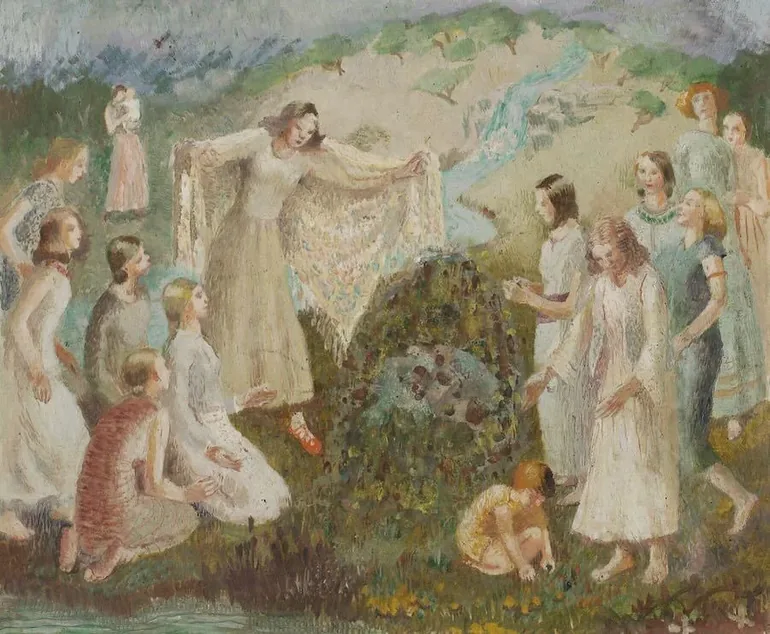
Evelyn Dunbar was a devout and committed Christian Scientist throughout her life. Much of her work reflects her beliefs, mostly indirectly but sometimes directly. Christopher Campbell-Howes, the artist’s nephew, has suggested that this work may be an interpretation of the hymn ‘Shall We Gather by the River,’ with words adapted from the original Baptist version of Revelation 22. It begs comparison with Stanley Spencer, whose art was a significant influence on her work.
The absence of men in the composition is deliberate, while the inclusion of young children and babies with the young women who make up the circle gathered around an ambiguous stone, in the centre, perhaps adds an air of mystery and female potency to the work.
Evelyn Mary Dunbar was the fifth child of William Dunbar, a tailor and purveyor of household linens, and Florence (née Murgatroyd), an amateur artist known for floral still lifes. Dunbar's childhood and adolescence were spent in Rochester, where she developed strong skills in draughtsmanship and composition, as well as a sophisticated sense of colour. Dunbar was encouraged by her mother and her aunt, and she was awarded an exhibition to the Royal College of Art in 1929, where she was greatly influenced by William Rothenstein, Allan Gwynne-Jones, Alan Sorrell, Percy Horton and Charles Mahoney. In her fourth and postgraduate year she was invited by Mahoney, her mural tutor, to join a team to decorate the hall at Brockley Grammar School for Boys (now Prendergast Hilly Fields School) with an extensive series of murals, mostly based on Aesop's fables. Started in 1933, they were inaugurated to acclaim in 1936.
In December 1939 Sir William Rothenstein suggested she should apply for employment as a war artist. She was given the remit of recording the Home Front of women's war time activities. Dunbar was the only female artist to be given a series of rolling employment contracts throughout the war, and by 1945 had completed 44 works.
In 1942 Dunbar married Roger Folley, a horticultural economist then serving in the RAF. While Folley worked at Oxford University, Dunbar taught at the Ruskin School of Art. She painted biblical and literary allegorical paintings at this period. In 1950 Folley was appointed to a senior post at Wye College, in Kent where the couple moved. Landscape and portraiture began to occupy her, and her only solo exhibition, held in Wye in 1953, reflected her wider subject matter (See Christopher Campbell-Howes, Evelyn Dunbar: A Life in Painting, 2016).
A retrospective of Dunbar’s work entitled Lost Works was held at Pallant House, Chichester, in 2015.