Gustave Achille Guillaumet
- Years
- –
- Country
- France
- Sold items
- 1
Biography
Read more Read less
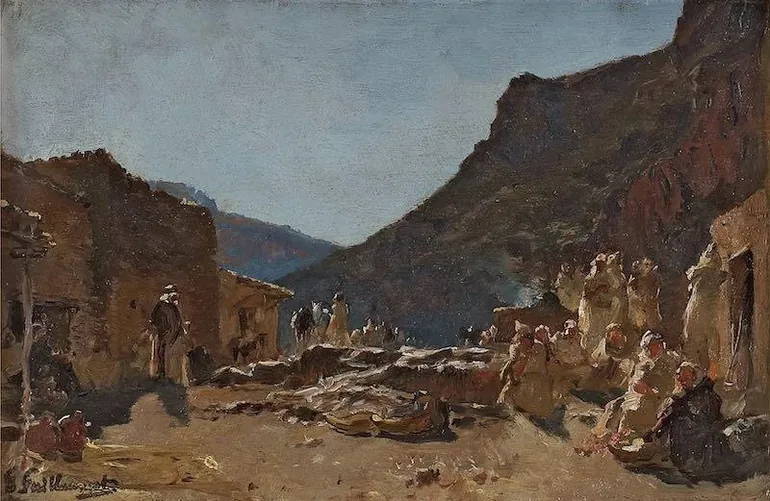
Guillaumet was a leading French Orientalist painter. From 1857 he studied under François-Édouard Picot and Félix Barrias at the École des Beaux-Arts. He won the second prize in the Prix de Rome for historical landscape in 1861 and set off for Italy. In Marseille he was delayed by a storm and by chance took a boat for Alger. He was entranced by Algeria and its light. During this first journey he made a large quantity of drawings and studies.
Between 1862 and 1884 Guillaumet returned to Algeria on ten or eleven trips, spending several months there each time, travelling around the country, living either in villages, or in Kabyle ksour (fortified villages) or with nomads. He also accompanied French expeditionary columns, as in 1864 and witnessed raids and the repression of insurrections. He wrote of his admiration for the landscape and his empathy for the population. Inspired by Fromentin’s works, he wrote texts about his Oriental experiences that appeared in the 'Nouvelle Revue' starting in 1879 and were later published together in an illustrated volume ‘Tableaux Algériens’ published posthumously in 1888.
Guillaumet, who at first had a studio at Sèvres, settled permanently in Paris in 1885. He lived there with Cécile Neinlist (1838-1929) whom he married in 1879 and with whom he had a son, Édouard, born in 1866. He exhibited regularly at the Salon from 1861 to 1880. He enjoyed early success and the French state acquired several of his pictures of rural and nomadic Algeria for the Luxembourg and provincial museums. After his premature death a first retrospective exhibition was organized at the Paris École des Beaux-Arts in 1888. (1)
His work may be found in Paris at the Musée d’Orsay and the Louvre. In Algeria, works by him are also on view in the public collections of the National Fine Arts Museum of Alger, at the National Museum Cirta in Constantine and the Zabana National Museum of Oran. He was the subject of a monographic exhibition’ L’Algérie de Gustave Guillaumet (1840-1887)’, (2) at the Musée des Beaux-Arts of La Rochelle, the Musée des Beaux-Arts of Limoges and at La Piscine in Roubaix (9 March – 2 June 2019).
The Kulka-Heissfeld collection was formed by Richard Kulka (1863- 1931) the son of a Jewish industrialist with textile factories in Jägerndorf who moved to Vienna and became a lawyer. The paintings in the collection were mainly 19th and early 20th century landscapes. On his death he left 1/3 of his collection to his sister Adele Kulka and 2/3 to Valerie Heißfeld. Valerie and her daughter Lotte left Vienna in 1938 after the Anschluss with some of the collection. They applied for export applications for numerous works of art and succeeded in taking many with them. Lotte succeeded in fleeing to England on 1 March 1939 with around 25 pictures, of which this is one. Her mother and aunt, Adela Kulka, perished at the concentration camp at Theresienstadt.
Exposition des œuvres de G. Guillaumet: au profit d’un monument à élever à la mémoire de F. Bonvin, Paris, École Nationale des Beaux-Arts, 7 to 31 January 1888.[↩]
Marie Gautheron (dir.), L’Algérie de Gustave Guillaumet (1840-1887), exh. cat. 2018-2019 Musée des Beaux-Arts de La Rochelle, Musée des Beaux-Arts de Limoges and La Piscine de Roubaix, 2018.[↩]