Louisa Seyffarth (née Sharpe)
- Years
- –
- Country
- United Kingdom
- Available items
- 1
Biography
Read more Read less
Louisa Sharpe, the daughter of William Sharpe, an engraver, was the most talented of four sisters, Eliza, Charlotte and Mary Ann, all of whom became artists. Raised in Birmingham, the sisters were encouraged to travel to France and Germany to visit galleries and were taught engraving. In 1816 the family moved to London.
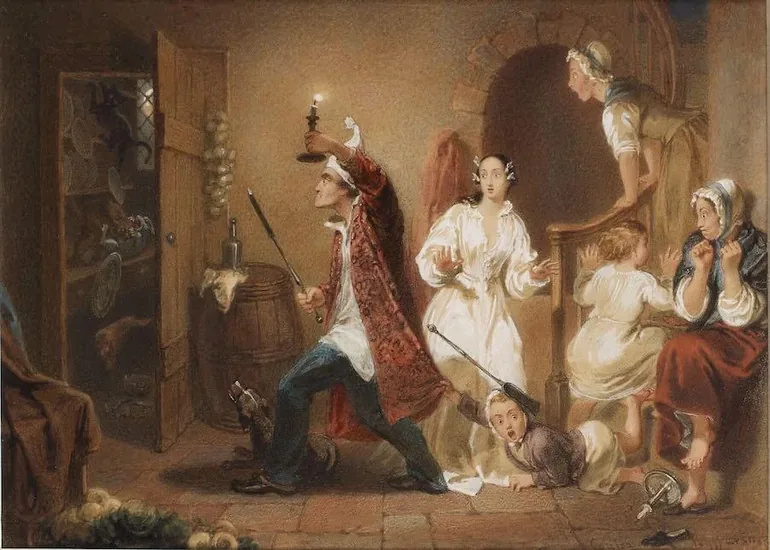
Ellen Clayton, the Victorian chronicler of female artists, mentions the present work by name and records its date as 1841 (see E. Clayton, English Female Artists, 1876, Vol. 1 pp. 379-80.)
The artist exhibited over thirty miniature portraits at the Royal Academy from 1817. Louisa developed her practise as a watercolourist and made highly finished costume subjects and domestic scenes such as the present work. Many of her drawings were engraved in popular annuals such as The Keepsake and the Forget-Me-Not Annual and Heath’s Book of Beauty. Her work was engraved by Charles Heath, John Henry Robinson and Francis Engleheart. In 1829 she was elected as a member of the Old Water-Colour Society, where she was to exhibit thirty-eight works.
Roget notes that her choice of subjects show a ‘taste for dramatic point, and a search for anecdote of a telling kind as well as a picturesque capacity’, extremely long titles and not a little humour (J.L. Roget, History of the Old Water-Colour Society, vol. II, reprint 1972, pp. 42-3).
In 1834 Louisa Sharpe married Professor Woldemar Seyffarth and moved to Dresden. The couple had two daughters, one of whom, Agnes, also became an artist. Her work continued to be exhibited in London until her death. Her husband was the King of Saxony’s Commissioner to the Great Exhibition in 1851.
Ellen Clayton describes the Sharpe sisters as ‘among the most remarkable figure painters’ and notes that the Duke of York, George III’s second son, was their first patron. She states that they were ‘among the first to originate the modern bold style of water-colour drawing’ (ibid Vol. 1 pp. 379-80).
Anna Bronwell Jameson (1794-1860) the British writer, art historian and feminist who visited Dresden in 1830s wrote of Sharpe’s work in the same breath as that of Elizabeth Sirani and Angelica Kauffman and remarked that it was supremely feminine (see Sketches of Art, Literature and Character, Harper and Brothers, 1834, p. 221).
Thomas Baring (1799-1873), the first owner of this watercolour was the son of Sir Thomas Baring (1772-1848) and a partner in Baring’s bank from 1828 and until his death in 1873.