Sarah Bowdich
- Years
- –
- Country
- United Kingdom
- Available items
- 1
Biography
Read more Read less
Sarah Bowdich or Sarah Lee, née Wallis (1791-1856), was the daughter of a grocer and linen-draper in Colchester, where she grew up and learnt how to fish. Her parents were prosperous, property-owning non-conformists, but her father went bankrupt in 1802 and the family moved to London, where Sarah met and married the explorer Thomas Edward Bowdich (1791-1824). He sailed in 1815 for Cape Coast Castle, in present-day Ghana, with the Royal African Company, and Sarah followed in 1816 with their new-born baby. During the voyage she caught a shark and helped put down a mutiny. While she waited for her husband to return from a trip to England, Sarah studied the local culture and natural history. Thomas led an expedition inland to the Ashanti kingdom while Sarah was the first European woman to collect plants systematically in West Africa.
The family settled in Paris in 1819 to study natural science in preparation for a further expedition to Africa and were assisted by the savant, Baron Georges Cuvier. They published English translations of French works, which were illustrated by Sarah. In 1822 they sailed for Africa, spending fifteen months in Madeira to study its natural history. Soon after reaching Bathurst (now Banjul in The Gambia), Thomas Bowdich died of fever in 1824.
To support her three young children Sarah Bowdich forged a career in the art of natural history and her work became very popular. In 1825 in London, she published her husband’s last work on Madeira with additions of her own. Her descriptions of new species and genera of fish, birds and plants established her as the first woman known to have discovered whole genera of plants. She remarried an assize clerk, Robert Lee in 1826.
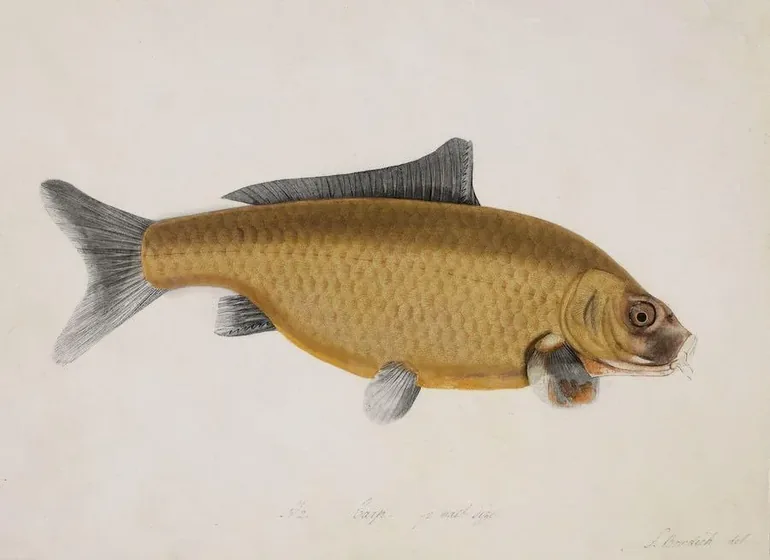
In 1826 Sarah Bowdich began her most famous work The Freshwater Fishes of Great Britain comprising forty-eight plates depicting fishes, with accompanying text. The work had fifty subscribers, headed by the Duke of Sussex, the sixth son of George III, and appeared in twelve fascicles of four plates each between 1828 and 1838. Remarkably, each illustration in each of the fifty copies is an original watercolour by the artist, not a hand-coloured print, totaling 2400 watercolour illustrations. She worked from life from just-caught specimens, beautifully illustrated by the lifelike golden sheen of the carp’s scales in the present work. Her preface comments: ‘Every Drawing has been taken from the living Fish immediately it came from the water it inhabited, so that no tint has been lost or deadened, either by changing the quality of that element, or by exposure to the atmosphere’.