William James Müller
- Years
- –
- Country
- United Kingdom
- Available items
- 1
- Sold items
- 2
Biography
Show more Show less
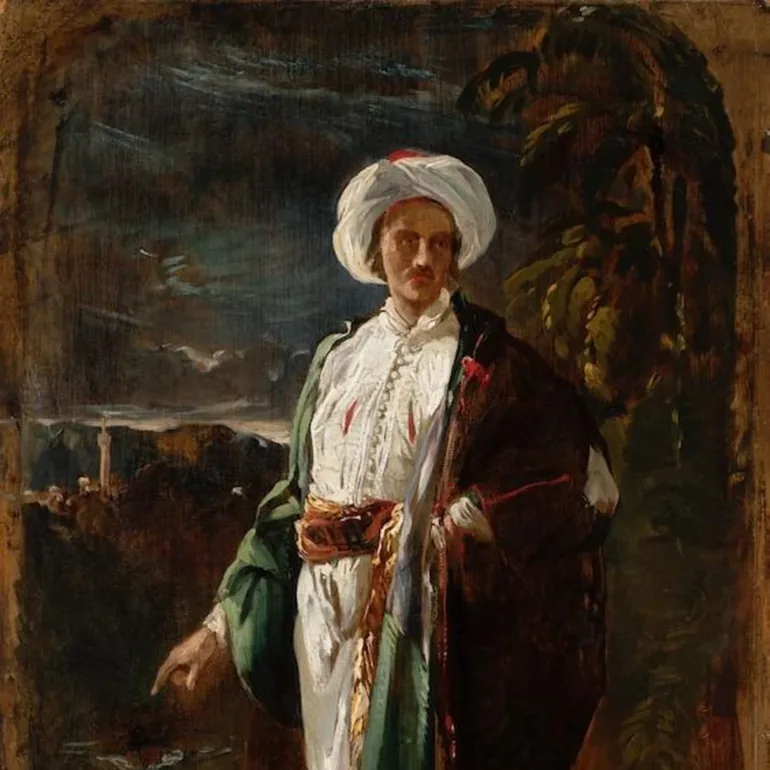
This spirited painting executed with great bravura was done shortly after the artist’s return from Egypt in 1839. Müller arrived in Egypt by steamer in November 1838. He was one of the first established European artists to visit Egypt and was there at the same time as David Roberts, although neither knew of the other’s presence there.
Müller was exhilarated by his arrival in the bustling metropolis of Cairo and was particularly intrigued by the slave market, which he described as ‘one of my most favourite haunts’ (W. J. Müller, ‘An Artist’s Tour of Egypt’, Art-Union 1, London, 1839, pp. 131-2).
Müller is the best-known artist of the Bristol School. His German father settled in the city and was the first curator of the Bristol Institution, the forerunner of the Bristol Museum and Art Gallery. His early exposure to art led to a short apprenticeship with James Baker Pyne and a friendship with the Reverend James Bulwer (1749-1879), a pupil of John Sell Cotman, whose collection of Norwich School drawings Müller would have known.
In 1833 Müller was one of the founders of the Bristol Sketching Club and his travels began the following year with visits to Holland, Germany and Venice. His 1838 trip started in Athens before he continued to Cairo. In 1840 he visited France and in 1843 he went to Lycia at the same time as Sir Charles Fellows’ expedition, during which he produced some of his finest watercolours. He died at the age of 43 after his return from Turkey.
Following Müller’s death, prices of his oil paintings rose dramatically in the salerooms. Articles on his work appeared regularly and in 1875 N. Neal Solly, the biographer of David Cox, wrote a long biography. In 1896 the Birmingham Museum and Art Gallery held a retrospective of 192 of Müller’s paintings, watercolour and drawings. His reputation was kept alive in Bristol where the 150th anniversary of his birth in 1962 was celebrated with an exhibition at Bristol Art Gallery, while in 1984 Tate Gallery held a show of his French and Lycian watercolours. In 1991 a major retrospective was held at Bristol Museum and Art Gallery, who hold the most comprehensive collection of his work, organised by Francis Greenacre, the renowed authority on Müller and the Bristol School.