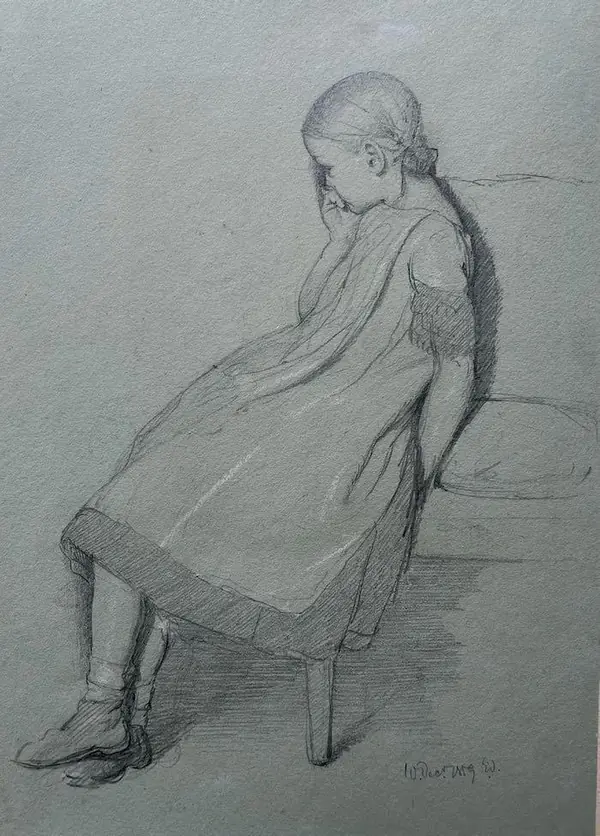
Dame Laura Knight RA Portrait of a Lady, possibly Lilian Jelly, or Lilian Ryan, Lady ‘Jane’ Kelly
- Reference
- 11038
- Category
- British Women Artists / Portraits
Signed and dated l.r.: Laura Knight/Dec 1923, watercolour and black chalk
Sight size 41.2 x 33 cm.; 16 1⁄4 x 13 inches
Whole sheet 45.6 x 39.5 cm; 41.2 x 15 1⁄2 inches; 16 1⁄2 x 15 1⁄2 inches
Provenance
Private collection, U.K.
Exhibited
MK Gallery, Milton Keynes, Laura Knight a panoramic view, 2021, ill. p. 144;
Nottingham Castle Museum, Laura Knight & Caroline Walker: A Female Gaze, 2021 (no catalogue)
Literature
Ed. Fay Blanchard & Anthony Spira, Laura Knight A panoramic view, 2022, ill. p. 144
This striking work by Laura Knight was drawn in 1923 and is a notable example of her ‘female gaze’. Her portrait drawings of women are invariably strong and vital. Here, she adds emphasis with her trademark black chalk creating strong lines, which contrast with the vivid background in blue watercolour.
It has been suggested that the sitter was Lilian Ryan, who was married to Sir Gerald Festus Kelly, one of the most fashionable society portraitists in Britain during the first half of the twentieth century and president of the Royal Academy from 1949 to 1954. During Kelly’s tenure as President, Lilian ‘Jane’ Ryan, as she was more commonly known, exhibited under the alias ‘Lilian Jelly’ to avoid accusations of cronyism.
From a working-class family, Ryan (c.1898 – c.1980) had been a model for Sir George Clausen in the 1910s, and he introduced her to Gerald Kelly in 1916. They were to marry four years later and spend over fifty happy years together: indeed, Gerald painted her portrait at least fifty times, exhibiting each year at the Royal Academy and titling them ‘Jane,’ his nickname for his wife. Her many likenesses became so recognisable that when Queen Mary was introduced to her, she exclaimed “Jane, of the many Janes!”.
Lilian took an interest in painting for herself in the early 1940s, and her husband encouraged her curiosity. She had a natural affinity to oils and she advanced quickly and exhibited at the Royal Academy for the first time in 1944, continuing to exhibit there for thirty years.
In 1936 Laura Knight was the first woman to be elected to full membership of the Royal Academy since its foundation in 1768. She battled against the structural inequalities of the art world throughout her professional life, from when she was excluded from the life room at Nottingham School of Art in 1891. In 1922 she wrote a pamphlet entitled Can Women Succeed as Artists where she identified inequality of opportunity as a major factor in the near exclusion of women from the arts in Britain. In 1937, she became the first woman to join the selection committee of the R.A., but was not invited to its annual banquet until 1967.
Knight campaigned for greater recognition and status for women in the arts throughout her career and was President of the Society of Women Artists from 1932-1968. Throughout her life she took the opportunity to promote herself and her work, fight for equal renumeration and obtain high-profile commissions.