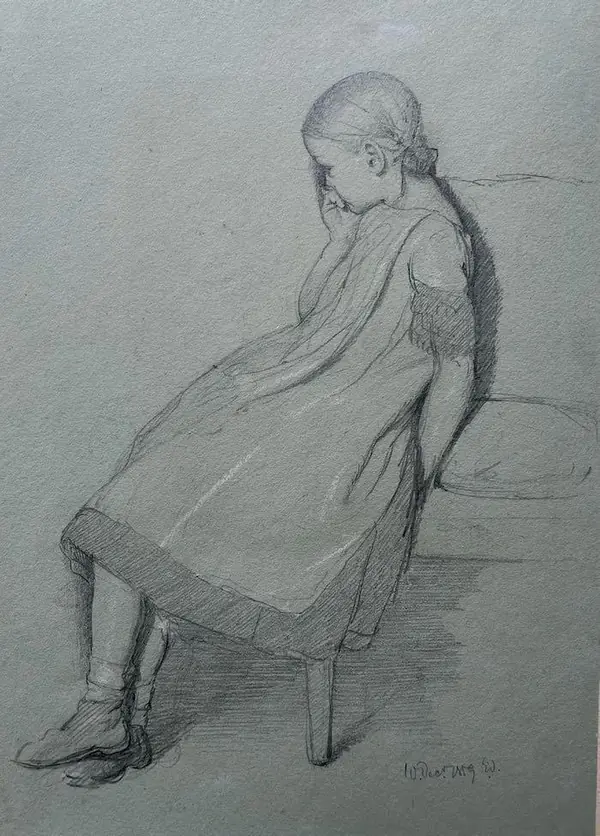
Isobel Smith, called Munia, the Angerstein family nurseSir Thomas Lawrence, P. R.A.height: 42 cm, width: 34.50 cm10881Pencil and black and red chalk, in original frame 42 x 34.5 cm.; 16 ½ x 13 5/8 inches Provenance: With Dorothy Roberts, Lincoln, 1996; Acquired by the previous owner in May 1996 from Douglas Turner; Private collection U.K. until 2021 Literature: Kenneth Garlick, ‘A Catalogue of the Paintings, Drawings and Pastels of Sir Thomas Lawrence’ in The Walpole Society; 1962–64, xxxix, 1964, p. 244 This unpublished drawing by Lawrence is an addition to a group of three known portraits of Munia. Lawrence became friendly with the Angerstein family in about 1790, when John Julius Angerstein (1735–1823) took charge of his financial affairs. Lawrence did paintings and drawings of most of the family, which included John Julius’ son, John Angerstein, M.P. (1772/3–1858), who married, in 1799, Amelia Lock, daughter of William Lock, who was also a friend and patron of Lawrence. Isabel Smith, or Munia, was nurse to the couple’s five children at Woodlands, the family residence which John Julius had built at Blackheath in 1770s. She was described as Russian in the papers of Miss May Rowley, a direct descendant of Elizabeth Julia Angerstein, daughter of John Julius. (Archive reference number NG14/230/1). This smaller version of this composition (measuring 35.5 x 30.25 cm; 14 x 11 15/16 inches) from May Rowley is now in the collection of Tate (T00768). The Tate drawing is inscribed on the back ‘This is a drawing of my Nurse Isabel Smith, called Munia, buried at Nh Willingham Lincolne. Wm Angerstein, drawn by Sr Thos Lawrence at Woodlands’. The Tate drawing originally belonged to Elizabeth, John Angerstein’s daughter, and was bequeathed to the nation in 1965 by May Rowley, who had inherited it from her grandfather Richard Freeman Rowley, Elizabeth’s husband. A second version, the same larger size as the present drawing, is in the possession of Viscount Daventry at Arbury, and was exhibited at Bristol City Art Gallery, ‘Exhibition of works by Sir Thomas Lawrence P.R.A.’, 1951, no. 48. Garlick records a further smaller version of this subject measuring 35.6 x 30.2 cm as being in the possession of Miss Keightley in 1925. She inherited the drawing from her father Archibald Keightley who was Lawrence’s executor. This drawing, in poor condition, is now in the Royal Academy (LAW/3/1). This work was illustrated in R.Brimley Johnson, Mrs Delaney, 1925, rep. facing p. 256 (incorrectly called Mrs Delaney). The financier and philanthropist John Julius Angerstein was born in St Petersburg in 1735 to a German family who had settled in Russia. He emigrated to England in about 1749 and built a fortune, partly from a career in the City of London, developing Lloyd’s insurance business. An active philanthropist, he was a patron of Lawrence’s and the artist advised him on his picture acquisitions together with Benjamin West. Angerstein started collecting around 1790. On Angerstein’s death the British Government purchased thirty-eight of his pictures and took over the lease of his Pall Mall town house. The public was able to view the collection here before the National Gallery, founded in 1824, was constructed in Trafalgar Square and it formed the nucleus of the gallery’s collection. Four paintings from the Pall Mall house were not purchased, a Reynolds portrait of Angerstein’s first wife and their first child, and three Fuseli paintings after Milton’s ‘Paradise Lost’which were returned to Angerstein’s heirs, and which remained at Woodlands until 1870. For further information about Woodlands and the collection kept there see Susanna Avery-Quash, ‘The lover of the fine arts is well amused with the choice pictures that adorn the house’: John Julius Angerstein’s ‘other’ art collection at his suburban villa, Woodlands https://academic.oup.com/jhc/article/33/3/fhx055/4773890 (Journal of the History of Collections, Volume 33, Issue 3, November 2021, fhx055, https://doi.org/10.1093/jhc/fhx055 See also Anthony Twist, A Life of John Julius Angerstein, 1735–1823: Widening circles of finance, philanthropy, and the arts in eighteenth-century London (London, 2006).
View details