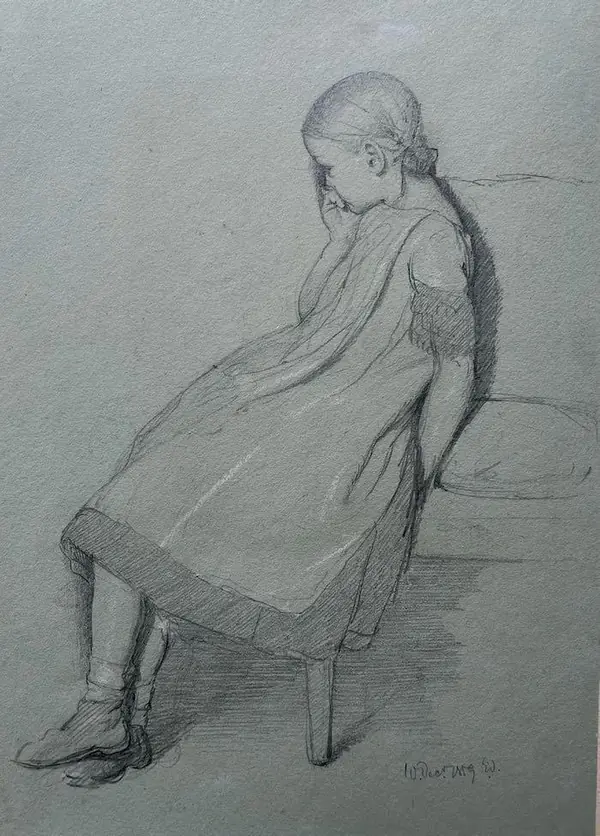
KT636
Watercolour over traces of pencil with touches of gum arabic and scratching out
21 x 29 cm.; 8 ¼ x 11 3/8 inches
Provenance
Agnew’s, (1891);
Private collection, Herefordshire until 2024
Samuel Jackson has been described as ‘the Father of the School’ of Bristol artists. His contemporary Francis Danby (1793-1861) wrote that ‘I know Jackson is a man of genius by being with him in Leigh Woods’ (see F. Greenacre and S. Stodard, ‘The Bristol Landscape-the Watercolours of Samuel Jackson’, 1986, p. 85).
In 1820s Bristol was booming, the end of the Napoleonic Wars contributing to its prosperity as a trading city, the port of Bristol second only to London. This was the moment the ‘Bristol School of Artists’ flourished; Jackson and Francis Danby were its best-known members. Their original contribution to art in Britain was founded in their plein air practise in the countryside around the city, Leigh Woods, the Nightingale Valley and the Avon Gorge.
Jackson was born in Bristol, the son of a partner in a firm of dry-salters with a Dutch grandmother, who dealt in the chemical products used in colour dyes and artists materials. It may be that in this business was the origin of the wide variety of pigments used in much of Jackson’s early work. Like many other Bristol artists Jackson travelled extensively and made frequent trips to Wales from 1825 through the 1830s and 1840s. In 1827 he visited Trinidad, St Vincent and Tobago in the West Indies. Scotland, the Lake District and Switzerland provided further subjects for his exhibited works. He lived in Bristol for his whole life becoming the elder statesman of the arts in the city.
Jackson’s work is well represented at the British Museum, Bristol City Art Gallery and the Yale Center for British Art amongst other institutions.