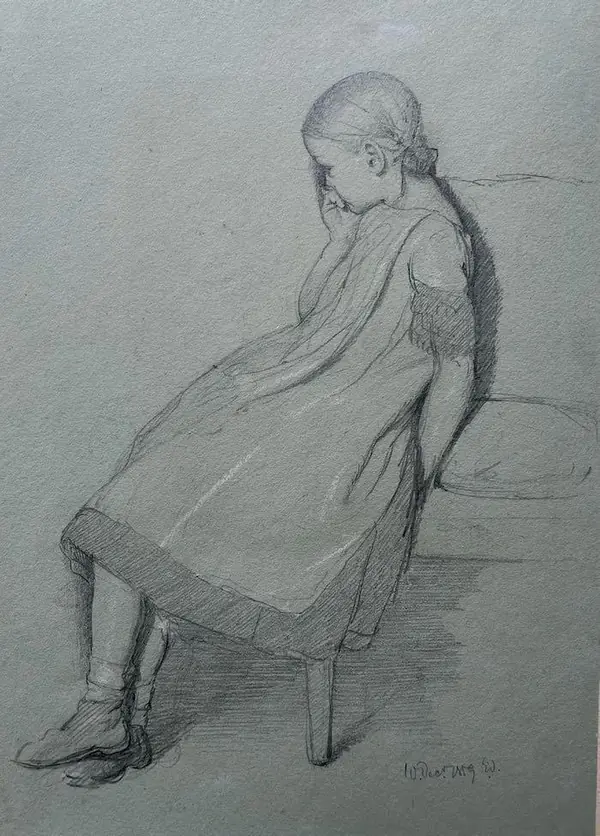
Slave Girl of the Cape
Signed with initials on border l.r.: F .Y. (?) M, and inscribed l.c.: Slave Girl of the Cape, watercolour on wove paper, with a laid paper border watermarked 1801
Drawing size 20.3 x 14.6 cm.; 8 1/8 x 5 ¾ inches, with border 25.8 x 20.2 cm.; 10 1/8 x 8 inches
This drawing came from a now disbound English album which contained works on paper from the late 18th and early 19th centuries.
Slavery in South African began around 1650 when the Cape colony was controlled by the Dutch East India Company (VOC) when Cape Town was founded as a supply port for their shipping. The trade continued until the eventual abolition of slavery in the Colony, by then under British rule, in 1834. The British had banned trading in slaves between her colonies in 1807 but the final emancipation was delayed until 1834.
You Might Also Like

Signed with initials on border l.r.: F .Y (?) M, and inscribed l.c.: Female Hottentot watercolour on wove paper, with a laid paper border Drawing size 20.6 x 15.3 cm.; 8 ½ x 6 inches, with border 26 x 20 cm.; 10 ¼ x 7 7/8 inches This drawing came from a now disbound English album which contained works on paper from the late 18th and early 19th centuries.
View details
Head and shoulders, pen and brown ink and wash 22.9 x 17.3 cm; 9 x 10 3/4 inches Provenance: Private collection, UK, bought at a charity auction at the Finchingfield Guildhall Landseer’s caricatures are a less well-known aspect of his art. They were made for private circulation and show Landseer’s effortless ability to capture the physical oddities of his subjects in an acute yet affectionate fashion. This drawing was once thought to depict Paganini but the subject is currently unidentified.
View details
Signed l.c.: R. Cooper, pen and brown ink and wash over pencil on laid paper partially watermarked with the Strasburg Lily 20 x 29.4 cm.; 7 7/8 x 11 5/8 inches Framed size 31 x 41 cm.; 12 1/4 x 16 1/8 inches Provenance Iolo Williams collection The artist was born in Edinburgh and trained with his father, the engraver Richard Cooper Snr (1701-1764). He moved to London in 1761, but by 1767 was on the Continent and in Italy by 1771, where he stayed until late 1775. Cooper spent most of his time in Rome and Naples and befriended Jacob More, with whom he travelled, and was later appointed as one of More’s executors. On his return to England Cooper taught drawing at Eton College and later he also taught Princess Charlotte. He produced a series of landscape prints based on his Italian work.
View details£ 2,200

Pen and brown ink and wash over traces of pencil on laid paper 12 x 9.7 cm.; 4 ¾ x 3 3/4 inches Framed in a dark wood moulding 31 x 29 cm.; 12 1/4 x 11 1/2 inches Provenance: Dickinson
View details
Watercolour over pencil heightened with bodycolour on thick cream paper 12.8 x 17.7 cm; 5 ⅛ x 7 inches Provenance: Frances Foster, the artist’s second wife. This delightful sketch is unusually spontaneous for the artist and shows the influence of John Ruskin. Huge skies are a frequent component of Birket Foster’s more finished watercolours.
View details
Sir Gerald Festus Kelly, P.R.A. (British 1879-1972) The Great Wall of China Oil on board Exhibited Martyn Gregory Gallery, ‘Modern British Painters’, October 1988, Catalogue no. 52, no. 34 This is a study for a painting of the same size of the Great Wall of China exhibited at the Royal Hibernian Academy, 1938, no.45 and the Royal Academy, London, Exhibition of Works by Sir Gerald Kelly, 1957, no.231. Born in London of Irish descent, Kelly was educated at Cambridge University, later living and studying art in Paris where he met Degas, Monet, Renoir and Sickert. Whistler was also an early influence as were Cézanne and Gaugin. Kelly was an enthusiastic traveller, visiting amongst other countries China, Spain, America, South Africa and Burma, where he painted some of his most characteristic and charming figure studies. He became a successful society portraitist whose sitters included Somerset Maugham, whom he painted several times, and he undertook numerous state portraits. Kelly is represented in many public collections, including the Tate, which holds seven works. He had retrospective exhibitions at the Leicester Galleries in 1950 and in 1957 at the RA. He was elected RA in 1930, was the Academy's Keeper from 1943-45 and President, defeating Augustus John in the election, from 1949-54. Kelly held a number of official positions, such as membership of the Royal Fine Arts Commission, 1938-43, and was knighted in 1945. Between 1909 and 1970 Kelly exhibited over 300 works at the RA. During his lifetime his work became well known through popular prints.
View details
Signed with initials l.r.: HSM, watercolour over traces of pencil on buff paper heightened with white 24 x 9 cm.; 5 ¾ x 3 ¾ inches Frame size 27 x 18.5 cm.; 9½ x 7 ½ inches Provenance The Fine Art Society Marks’ earlier works were usually historical and literary, especially Shakespearian and sometimes humorous. However, he became increasingly interested in painting birds and this body of work was highly praised by John Ruskin. Marks had three exhibitions in six years at the Fine Art Society in London, the first of which was Birds in Bond Street in 1889. He was a frequent visitor to London Zoo where he was frequently approached by other curious visitors . He wrote in his preface to the 1890 catalogue: “The most common remark I hear is, “Ah pretty creature! Don’t he seem to know he’s sitting for his picture?” and concluded “… I hope I may be excused, and not held too eccentric, in preferring to converse with a parrot for one hour, rather than with a politician for two”. The Victoria and Albert Museum have a holding of his work. The artist was born in London, the fourth child of John Isaac Marks, a solicitor. He studied in London at the Royal Academy Schools and later in Paris. He exhibited at the Royal Academy and elsewhere from 1853. He was elected ARA in 1870 and became a full RA in 1878.
View details
Inscribed on original label now attached to backboard: General Distant View of the Carnarvonshire Mountains, seen from the road beyond Llangerniew,/going by the Vale of the Elwyn from St Asaph to Llanrwst-Principal in this Towering Group, are Moel Siabod, Snowdon, The Glyders/ and Trevaon Denbighshire, watercolour over pencil. 13 x 20.8 cm.; 5 1/8 x 8 ¼ inches Provenance George Greville, 2nd Earl of Warwick (1746-1816), no. 17, part of an album sold at Sotheby’s, 17 June 1936; With Leger Galleries, 1980; Christie’s, London, 20 November 1984, lot 113, where bought by a private collector, until 2024 Smith seems to have been fascinated by the Welsh countryside and dated drawings, often inscribed ‘taken on the spot’, point to visits nearly every year from 1784-1798, after his return from Italy. The artist was born in Cumberland and patronised by 2nd Earl of Warwick who sponsored his travels to Italy in 1776 and whose name became the artist’s sobriquet. Smith spent five years in Rome and Naples, befriending William Pars and Thomas Jones, in whose Memoirs he is frequently referenced. He travelled home in 1781 through Switzerland with Francis Towne and was among the most admired watercolourists of his day.
View details
Inscribed and dated l.r.: Patti 4 July 1847, inscribed: sloping towards x which is a very deep stuffy vegetable dell and with colour notes, numbered 212, pen and brown ink with pencil 20.2 x 44.5 cm.; 8 1/8 x 17 ½ inches, framed size 37 x 60.5 cm.; 14 1/2 x 23 3/4 inches Provenance Mary Ann Streeter (1932-2023), Boston, by descent until 2025 £5500 Lear travelled to Sicily between May 3 and July 15, 1847, with John Joshua Proby, later the 2nd Earl of Carysfort. They were to make two other tours together that year, to Calabria and Naples. Patti is a village in North-Eastern Sicily in the province of Messina between Milazzo and Capo Calvà, which includes the ancient Graeco-Roman village of Tindari with its famous Sanctuary. After graduating from Radcliffe College (Harvard University) with a degree in Fine Arts, Mary Ann Streeter moved to London for a year and started buying Lear watercolours in the late 1950s. She built up a large collection of Lear’s work.
View details£ 5,500

Watercolour over pencil 20.5 x 38 cm.; 8 1/8 x 15 inches Provenance Walter Coleridge Richmond (1852-1931), the son of the artist, by descent; With Radnorshire Fine Art Richmond continued to draw and paint landscapes throughout his successful career as a portraitist. These works remained private and stayed mainly in his family. This beautiful sketch has a directness which reflects his enjoyment of the opportunity for contemplation when drawing from nature.
View details