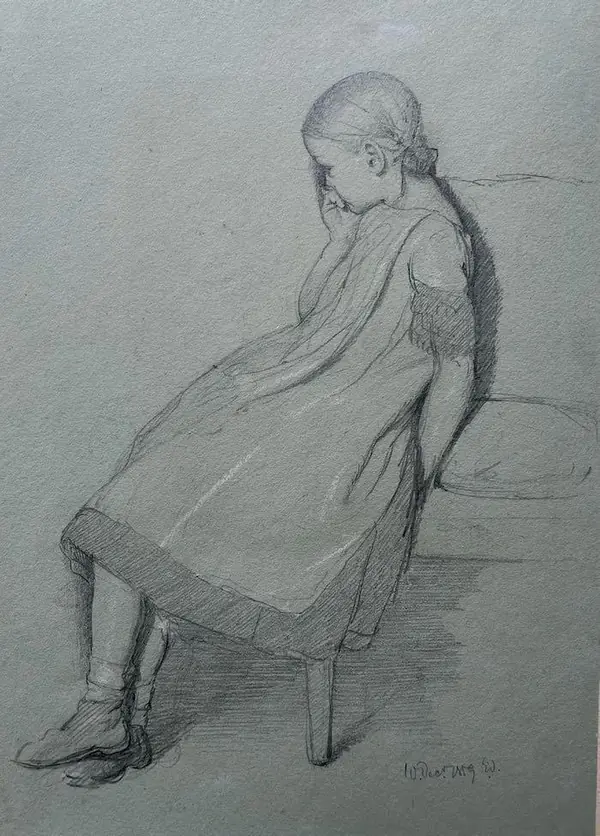
Alphonse Legros Tête d 'homme
- Reference
- 10882
- Category
- Frieze Masters 2026 / Portraits
Signed with initials and dated u.r.: A.L./1880, sepia wash over pencil with a touch of red chalk on laid paper, in the original frame
44.5 x 32 cm.; 17 ½ x 12 ½ inches
Provenance
Frank Edward Bliss until 1923; (L. 265 and 988 supplement), his sale at Christie’s, London, 9 February 1923, lot 25;
Arthur Crossland, Heaton Mount, Bradford,
His sale at Christie’s, London, 3 February 1956, lot 59, bt, Meatyard;
Arnold Fellows collection no. 322;
Bequeathed to Queen Mary’s Grammar School, Walsall until sold by a charitable trust, 2023
Exhibited
City of Bradford Corporation Art Gallery Jubilee Exhibition, 1930, no. 453
This powerful drawing is a fine example of the extraordinary technique of Alphonse Legros. A painter, sculptor and etcher, Legros was born in Dijon and spent his early career in Paris. Legros was encouraged by Whistler to come to London in 1863. He was Professor of Fine Art at the Slade from 1875-1892, where his insistence on the quality of line laid the foundation for the Slade tradition of fine draughtsmanship. He set out to broaden the syllabus, introducing etching and, in 1884, classes in medal making.
Frank Edward Bliss (1847-1930) was born in America and moved to London in 1886. He amassed a large collection of modern prints from 1905 and put together a famous collection of the work of Legros (see the British Museum letterbook for 1929). He sold them in three sales in 1913, 1920 and 1923. Bliss returned to the USA in 1923 to live in California.
Arnold Fellows was a pupil at Queen Mary’s Grammar School, Walsall, between 1911 and 1917. He became a master of the school for a brief period, before moving to spend the remainder of his life as a teacher at Chigwell School in Essex. Fellows devoted much of his life to collecting art, notably works on paper, and eventually donated his entire collection to Queen Mary’s Grammar School. He was the author of The wayfarer's companion: England's history in her buildings and countryside, published by Oxford University Press, 1937.