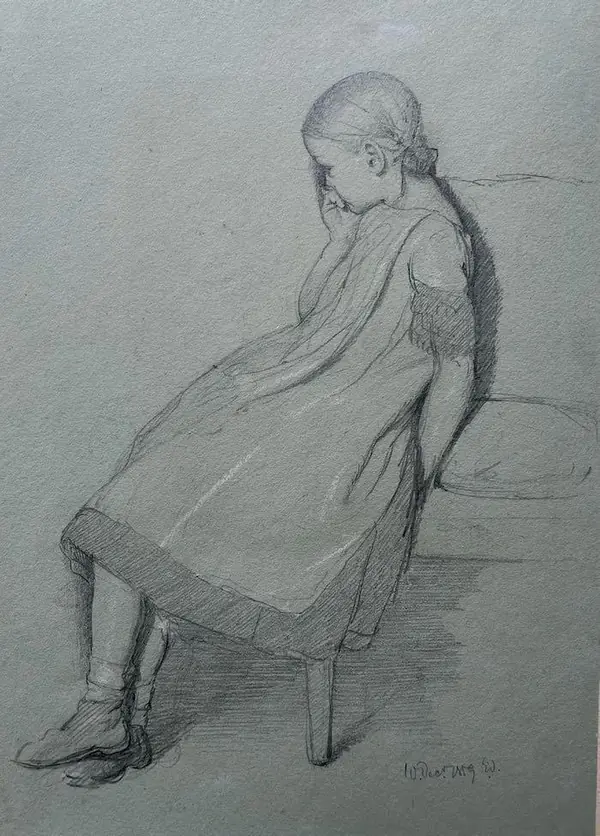
Inscribed verso: At Naples, and inscribed in pencil on reverse of old mount: At Naples, watercolour over pencil on laid paper watermarked with the Strasburg Lily, on the artist’s original wash-line mount
28.9 x 34.5 cm.; 11 3/8 x 13 ½ inches
Provenance
Walker’s Gallery, 27 June 1944;
With Agnew’s, London, (11245) until 2 March 1945 when sold to
Sir Francis Watson, KCVO, FSA (1907-1992);
His sale Christie’s, London, 10 July 2014, lot 196;
With Karen Taylor Fine Art;
Private collection U.K. until 2024
Smith was in Naples from March 1778 until July 1779, sponsored by George Greville, 2nd Earl of Warwick (1746-1816), the nephew of Sir William Hamilton (1730-1803), the British ambassador in Naples, who supported him in Italy from 1776-1781 and was to own around seven hundred drawings by him. The artist arrived the year after the eruption of Vesuvius which can be seen smouldering in this drawing, a subject which fascinated Smith and many contemporaries alike. His highly popular Italian drawings earned him another eponym, John ‘Italian’ Smith and embody the eighteenth century appeal of the Picturesque and the Grand Tour.
While he was in Italy visiting Rome, the Campagna and Naples, Smith met many other British artists working there, notably J.R. Cozens, Francis Towne and Thomas Jones.
Smith’s work was admired by his contemporaries for its elegant beauty and particularly for his accomplished handling of colour washes, amply demonstrated in this work, particularly in the sky.
The artist Julius Caesar Ibbetson noted, ‘In tinted drawings no one, I believe, ever came near the tint of nature as Mr John Smith’.
Sir Francis Watson was the Director of the Wallace Collection, London from 1963-1974 and a leading authority on the arts of Italy and France in the eighteenth century. His 1956 Catalogue of Furniture in the Wallace Collection raised the level of scholarship in the decorative arts and was internationally applauded. In the late 1960s he catalogued the Wrightsman collection in the Metropolitan Museum of Art in New York. The author of books on Tiepolo, Canaletto, and Fragonard he was Surveyor of the Queens’ Works of Art, Slade Professor of Fine Art at Oxford (1969-70) amongst several other prestigious academic positions. He derived great pleasure from his own collection, and enjoyed the hunt for reasonably priced treasures, as hilariously described in his obituary in The Independent by Sir Brinsley Ford.