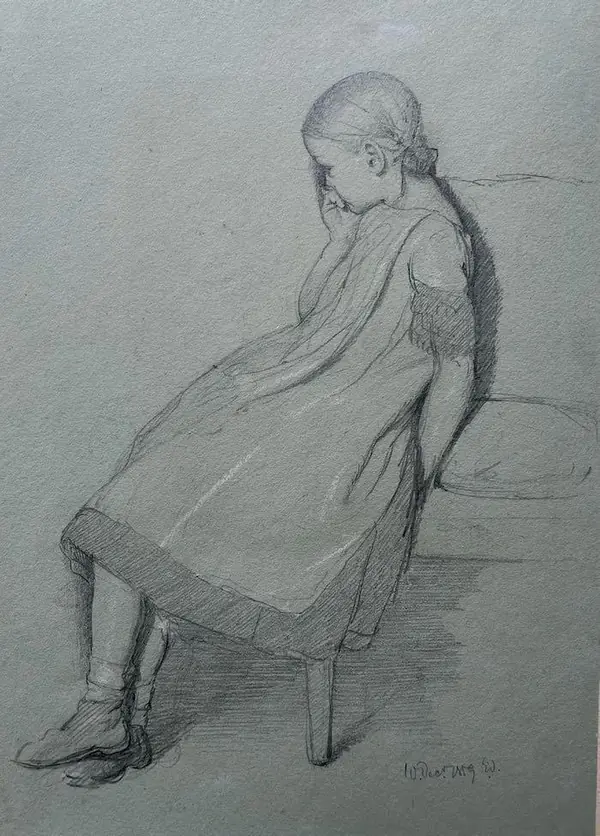
Evelyn De Morgan A study for Boreas and the Fallen Leaves, c. 1910 - 1914
- Reference
- 10979
- Category
- Portraits
Evelyn De Morgan (1855 – 1919)
A study for Boreas and the Fallen Leaves, c. 1910 - 1914
Coloured chalks on buff paper
36.8 x 23.5 cm.; 14 3/8 x 9 ½ inches
Provenance
Private collection, U.K. and by family descent until 2024
Boreas was the Greek god of the north wind. In this study for Boreas and the Fallen Leaves in the collection of the De Morgan Foundation (P_EDM_0044) he is shown with his lips pursed, blowing the wind. The oil depicts him by a gnarled oak tree, blowing the leaves which turn to maidens with long golden hair as they fall to the ground.
The most important of the four wind gods, Boreas is usually depicted as a winged man of mature age, his hair floating in the wind. He had two faces, so he could see where he was going and from where he was coming.
https://www.demorgan.org.uk/collection/boreas-and-the-fallen-leaves/
The model for Boreas was the professional artist’s model, Alessandro di Marco from Piedmont. Evelyn De Morgan made studies of him on several occasions, initially when she was at the Slade and later in her own studio. This drawing probably dates from 1880s. Another study of Alessandro, for her 1899 painting The Valley of Shadows is on the same buff colour paper, and also probably dates to the 1880s: https://www.demorgan.org.uk/collection/study-of-a-head-male/
Di Marco was used by Evelyn De Morgan in another work depicting Boreas, Boreas and Oreithyia (De Morgan Foundation P_EDM_0040, 1896). He also features in Aurora Triumphans (1876), Life and Thought Have Gone Away(1893), The Poor Man Who Saved the City (1901), The Marriage of St. Francis and Holy Poverty (1905), The Gilded Cage, A Soul in Hell (with curly hair) and '1914'.
Di Marco modelled for Frederic, Lord Leighton (1830-1896) in Rome. Alessandro was one of the artists’ models working in London around 1870. Sir William Blake Richmond (1842-1921) described him as “a fellow so graceful and of such a colour, a kind of bronze gold” (S.T. Buckle, British Art Journal, Autumn 2012, Vol. 13, Issue 2, p.67:
https://www.eb-j.org/pdfViewer/articles/MTA1OA==
2012). William Hamo Thornycroft noted in his diary that Alessandro sat for long periods of time without a break. He was the model for Merlin in Edward Burne-Jones’s earlier work ‘The Beguiling of Merlin’ (1872-77). He was also photographed by Julia Margaret Cameron. George Richmond described him as ‘the living embodiment of a classical sculpture’.
The first owner of this drawing was a keen collector of De Morgan’s work, and also owned ‘The Dryad’ (1884-5) now in the De Morgan Foundation.
Evelyn De Morgan, who attended the Slade School of Art, was influenced by George F. Watts and Edward Burne-Jones and by the work of her uncle John Roddam Spencer Stanhope. She often visited Stanhope in Florence, where she developed a love of the work of Botticelli and quattrocento art. She first exhibited at the Grosvenor Gallery in 1877. In 1887 she married the ceramicist William De Morgan, with whom she often wintered in Florence.
De Morgan’s work is held in many national collections including the Walker Art Gallery, Liverpool, National Trust properties Wightwick Manor, Wolverhampton and Knightshayes Court, Devon, the Russell-Cotes Art Gallery and Museum, Bournemouth, the National Portrait Gallery, London and Southwark Art Collection, London.
With thanks to Scott Thomas Buckle for his comments on this work.