
Signed, inscribed and dated below: Drawn 1785, by I. Johnson. Woodbridge.-/This OAK stands in Winfarthing, Norfolk, on the Estate of the Rt. Hon: Lord ALBERMARLE./Circumference at Base 51 Feet, at three Feet high 32 Feet, at six Feet, 30 Feet Circum. Height 60 Feet., watercolour and bodycolour over pencil with pen and black ink.
Image size 34 x 29 cm.; 13 3/8 x 11 3/8 inches, sheet size 40 x 33 cm.; 15 ¾ x 13 inches
Provenance
Simon Carter, Woodbridge;
R. Geoffrey Smith, Berveriche Manor Farm, Middleton;
Martyn Gregory Gallery, London;
Hugo Burge (1972-2023)
Literature
Huon Mallalieu, Dictionary of British Watercolour Artists up to 1920, vol. III, 1990, p. 191, ill.;
John Blatchley, Isaac Johnson of Woodbridge: Georgian Surveyor and Artist, 2014, pp. 12-16
The artist was a surveyor and antiquarian as well as an artist who lived in Woodbridge, Suffolk for his adult life. Around 1785 he was considering a volume illustrating the most remarkable trees of Norfolk and Suffolk which never came to fruition, but for which the current drawing would have been a likely candidate.
White's History, Gazetteer, and Directory of Norfolk, 1883 describes the tree which stood on the estate of the Earl of Albermarle:
The celebrated 'Winfarthing Oak,' probably the largest in England except the one at Cowthorpe, in Yorkshire, stands near the Lodge farmhouse, and is a grand and picturesque old ruin. It measures 70 feet round at the roots, and 40 feet in the middle of the main stem, and must have been at one time a magnificent spreading tree, with enormous arms. It is traditionally said to have been called the 'Old Oak' in the time of the Conqueror, and is usually considered to be more than 1200 years old. It is now a mere shell, bleached snowy white, and capable of containing a large number of persons in its interior. It still retains vitality on its south side, and three years ago a rook's nest was built in its branches.
You Might Also Like
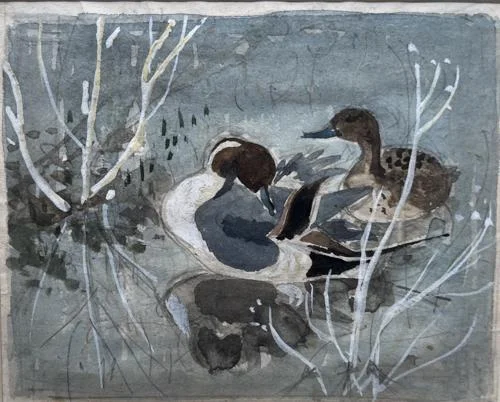
KT601 Charles Frederick Tunnicliffe, OBE, RA (1901-1977) Sketch for a pair of pintail ducks Watercolour over pencil heightened with white Sight size 9 x 11 cm.; 7 ½ x 4 ¼ inches Provenance Private collection, UK, sold at Christies South Kensington, London, 3 November 2010, part lot 57 Guy Peppiatt Fine Art
View detailsOne hundred and forty-four drawings on sixty-eight pages, laid into an album bound in vellum, the fly leaf with a large label inscribed: Miss Stones/First Efforts/plates.71 The drawings are of various sizes, on laid paper, each page 31.5 x 19.7 cm.; 12 1⁄4 x 7 3⁄4 inches Provenance Private collection, U.K.;Private sale by Sotheby’s Australia, January 25 2001; Patrick Dockar-Drysdale (1929-2020) Exhibited Tate Britain, 'Now you See Us- Women Artists in Britain 1520-1920', May - October 2024, ill. p.42, p. 205 Sarah Stone was the daughter of James Stone, a fan painter and is thought to have assisted her father. The family lived in London. The dated drawings in this album suggest that Stone executed many of them when she was ten or eleven years old and identify her as something of a child prodigy. This album contains many copies from drawing books which were a popular means of allowing an artist to develop their technique by copying. The number of drawings and the repetition of certain subjects reflect a systematic approach and a determination to improve and there are drawings after Holbein, Ribera and Boucher, the minor details may be after Le Brun. One of the drawings is inscribed ‘The New Drawing Book‘ which could be a reference to Francis Vivares, A New Drawing Book, in the Manner of Chalk fit for Youth to Draw after. 6 sepia soft ground etchings, by W. Hebert after Vanloo and Boucher, 4to. Frans. Vivares. Sept. 1759. The plates in this were in the manner of red chalk. The range of subjects in the present album suggests Stone was using one of the compilation drawing books, such as Carrington Bowles, The School of Art; or, most compleat Drawing-Book extant: consisting of an extensive series of well chosen examples, selected from the designs of those eminent masters, Watteau, Boucher, Bouchardson, Le Brun, Eisen, &c. engraved on sixty copper plates, and performed in a method which expresses the manner of handling the chalk, 1765 and later editions.
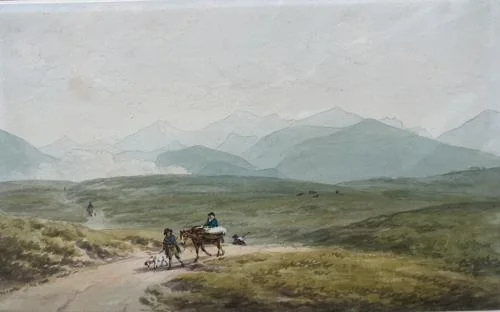
View detailsInscribed on original label now attached to backboard: General Distant View of the Carnarvonshire Mountains, seen from the road beyond Llangerniew,/going by the Vale of the Elwyn from St Asaph to Llanrwst-Principal in this Towering Group, are Moel Siabod, Snowdon, The Glyders/ and Trevaon Denbighshire, watercolour over pencil. 13 x 20.8 cm.; 5 1/8 x 8 ¼ inches Provenance George Greville, 2nd Earl of Warwick (1746-1816), no. 17, part of an album sold at Sotheby’s, 17 June 1936; With Leger Galleries, 1980; Christie’s, London, 20 November 1984, lot 113, where bought by a private collector, until 2024 Smith seems to have been fascinated by the Welsh countryside and dated drawings, often inscribed ‘taken on the spot’, point to visits nearly every year from 1784-1798, after his return from Italy. The artist was born in Cumberland and patronised by 2nd Earl of Warwick who sponsored his travels to Italy in 1776 and whose name became the artist’s sobriquet. Smith spent five years in Rome and Naples, befriending William Pars and Thomas Jones, in whose Memoirs he is frequently referenced. He travelled home in 1781 through Switzerland with Francis Towne and was among the most admired watercolourists of his day.
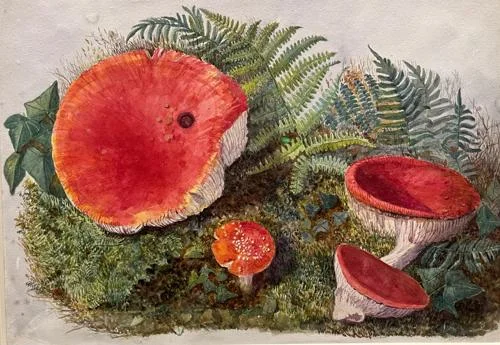
View detailsKT727 English School, 1870s Russula emetica, commonly known as the sickener Watercolour 25.5 x 35.6 cm.; 10 x 14 inches In the 1870s the Keswick Sketching Club, an amateur art group in the Lake District was founded by John William Oddie (1839–1923) with the support of John Ruskin (1819–1900). This drawing was made by one of its members. Keswick Sketching Club is believed to have been instigated in the 1870s by the artist and designer John William Oddie (1839–1923), who lived at Lyzzick Hall, Keswick. Oddie studied at Wadham College, Oxford in the 1860s and became a Life Fellow at Corpus Christi College. It appears that it was Oddie who facilitated Ruskin's obtaining rooms at Corpus, where he was admitted as an Honorary Fellow. Oddie and Ruskin were in regular contact, and in 1874 Oddie enlisted Ruskin's assistance with Keswick Sketching Club. Ruskin responded with enthusiasm as the club's activities gave him opportunity to put into practice what he was promoting in his Oxford Drawing School and his various drawing manuals. Ruskin advises Oddie on sketching exercises for the Club, and writing to Oddie in 1874 he states that 'certainly there is one exercise — which I must send you example of Outline of a strawberry leaf'. In April 1875 Ruskin sends his critique to the Club, writing: 'To the Members of the Keswick Sketching Club, / In the work of the Club generally I find the sense of colour excellent, the industry great; the ability in many cases beyond that of most professed artists, several pieces of texture and local hue being given with singular feeling and skill.' In the 1880s Ruskin and Oddie continued their involvement in art teaching in the Lakes, founding the Keswick School of Industrial Arts. Oddie later established the Lyzzick Hall Art School.
View details£ 1,100
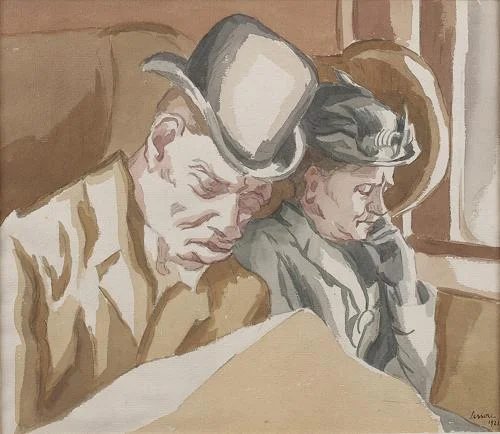
KT663 Thérèse Lessore (1884 – 1945) In a Belgian Train Signed and dated l.r.: Lessore/1921, watercolour over pencil, with a pencil outline, inscribed in pencil with title beneath mount l.r.: in a Belgian train Image 23 x 26.5 cm.; 9 x 10 3/8 inches, full sheet 28 x 32 cm.; 11 x 12 5/8 inches Provenance Bonhams, London, 17 November 1988, lot 27; Sandra Lumis Fine Art, London; Bernard Kelly, bought from the above, his sale at Lyon and Turnbull, London, 15 January 2025, lot 225 The artist came from an artistic family and was the daughter of the painter Jules Lessore (1849-1892) and sister of the sculptor Frederick Lessore (1879-1951). Born in Brighton, she attended the South-Western Polytechnic Art School and the Slade School of Fine Art from 1904–9, where she won the Melville Nettleship Prize for Figure Composition. She exhibited regularly at the New English Art Club and the Goupil Gallery, and had her first solo exhibition at Eldar Gallery, with a catalogue preface written by Walter Sickert. She was a founder member of The London Group, the artist-run organisation of radical painters which grew out of The Camden Town Group, where she was to exhibit regularly. Lessore was amongst the most talented female artists of The London Group. She married firstly the artist Bernard Adeney and in then 1926 she married Walter Sickert, as his third wife. He described her as “a Persian miniature”. The two artists shared a love of the music-hall and the circus which feature in both their work. Her contributions to exhibitions at The London Group were fewer after her marriage to Sickert who was 24 years her senior and for whom she cared and acted as his artist’s assistant. This acutely observed watercolour of two fellow passengers observed by the artist in Belgium a few years after the end of WWI verges on caricature.
View detailsStamped with the artist’s stamp l.l., watercolour over pencil heighted with white on rough buff paper 32.3 x 46.5 cm; 12 5/8 x 18 ¼ inche Provenance: Christie’s, London, the Artist’s Studio sale, March 13 -17, 1884 (13 gns); The Fine Art Society, London, April 1966; Hermione Hobhouse (1933-2014); By family descent until 2020 Exhibited: Glasgow International Exhibition, 1888 Literature: Delia Millar, 'The Victorian Watercolours in the Collection of Her Majesty The Queen', 2 vols., London, 1995, no. 3422 Osborne House on the Isle of Wight was a summer retreat built for Queen Victoria and Prince Albert between 1845 and 1851, designed by Albert himself in the style of an Italian palazzo. The stone lions shown here at the foot of the steps, copied from the antique, were acquired in January 1851, and were in place by 9 March 1851. The groups of children possibly include Princess Helena and Princess Louise, described by their mother as 'looking extremely pretty in little blue silk polkas, with white silk hats' (Queen Victoria’s Journal, 15 August 1851). There is another smaller version of this watercolour in the Royal Collection dated August 1851 (RCIN 919847). The present drawing would seem to be the preliminary drawing as passages are unfinished. The version in the Royal Collection has an additional figure group at the bottom of the stairs. Leitch also drew two further watercolours of Osborne under construction drawn circa 1847 (RCIN 91982 and 91983). William Leighton Leitch was one of Queen Victoria's favourite watercolour artists, and she commissioned many watercolours from him for her View Albums. Leitch also taught watercolour to the Queen and her children, all of whom copied his work. He stayed at Osborne from 31 July 1851 and for most of August that year. It has been suggested that this drawing may have been made as a drawing lesson for some members of the Royal Family. Hermione Hobhouse was an architectural historian and preservation campaigner. During her distinguished career, during which she acted as secretary of ‘The Victorian Society’ from 1976-1983, she wrote numerous books, including Prince Albert: His Life and Work, 1983. Stamped with the artist’s stamp l.l., watercolour over pencil heighted with white on rough buff paper 32.3 x 46.5 cm; 12 5/8 x 18 ¼ inche Provenance: Christie’s, London, the Artist’s Studio sale, March 13 -17, 1884 (13 gns); The Fine Art Society, London, April 1966; Hermione Hobhouse (1933-2014); By family descent until 2020 Exhibited: Glasgow International Exhibition, 1888 Literature: Delia Millar, 'The Victorian Watercolours in the Collection of Her Majesty The Queen', 2 vols., London, 1995, no. 3422
View detailsOil on paper laid down on canvas 15.1 x 21.6 cm.; 6 x 8 ½ inches Frame size 25.5 x 32 cm.; 10 x 12 ½ inches Engraved By the artist as a lithograph on chine collé, printed by Charles Motte, 1828, plate 8 Newton Fielding produced a series of lithographs of mammals which were printed by Charles Motte in 1828. The artist was the youngest son of portrait painter Nathan Theodore Fielding. From 1827 to 1830 he lived in Paris, where he ran the family engraving business, at which William Callow worked. He was closely associated with the Anglo-French circle of artists centred around Bonington and Delacroix. He collaborated with his brothers Thales and Theodore in England before returning to France where he built up an extensive teaching practice, with pupils including members of the family of King Louis- Philippe. He published a number of teaching manuals and lived in France until his death.
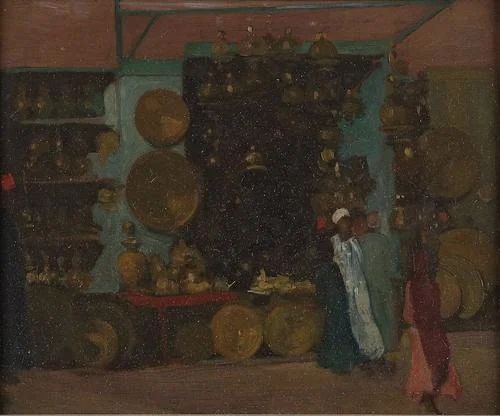
View detailsOil on panel 22 x 27 cm.; 8 ¾ x 10 5/8 inches Provenance The artist’s widow, Lady Kelly; Michael Parkin Fine Art Ltd; From whom purchased by J.G. Cluff, private collection U.K. until 2022 Born in London of Irish descent, Kelly was educated at Cambridge University, later living and studying art in Paris where he met Degas, Monet, Renoir and Sickert. Whistler was also an early influence as were Cézanne and Gaugin. Kelly was an enthusiastic traveller, visiting many countries from Egypt to China. His sketches of his travels are pleasingly spontaneous and tend to be painted more freely than his finished portraits. He became a successful society portraitist whose sitters included Somerset Maugham, whom he painted several times, and he undertook numerous state portraits. Kelly is represented in many public collections, including the Tate, which holds seven works. He had retrospective exhibitions at the Leicester Galleries in 1950 and in 1957 at the RA. He was elected RA in 1930, was the Academy's Keeper from 1943-45 and President, defeating Augustus John in the election, from 1949-54. Kelly held a number of official positions, such as membership of the Royal Fine Arts Commission, 1938-43, and was knighted in 1945. Between 1909 and 1970 Kelly exhibited over 300 works at the RA. During his lifetime his work became well known through popular prints.
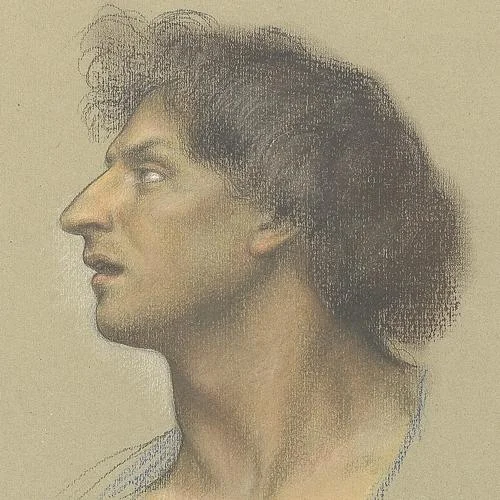
View detailsKT748 Evelyn de Morgan (1855-1919) A head study of the model Alessandro di Marco Coloured chalks on coloured paper 35.5 x 32.5 cm: 14 x 12 ½ inches Provenance Private collection, U.K. Alessandro di Marco was a professional artist’s model from Piedmont. Evelyn De Morgan made studies of him on several occasions, initially when she was at the Slade and later in her own studio. This drawing probably dates from 1890s. Another study of Alessandro in the De Morgan Foundation collection, for her 1899 painting The Valley of Shadows is not dissimilar to the present work (D_EDM_0038): https://www.demorgan.org.uk/collection/study-of-a-head-male/ Di Marco was used by Evelyn De Morgan in two works depicting Boreas, 'Boreas and Oreithyia' (De Morgan Foundation P_EDM_0040, 1896) and 'Boreas and the Fallen Leaves' (c. 1910-14). He also features in 'Aurora Triumphans' (1876), 'Life and Thought Have Gone Away’ (1893), 'The Poor Man Who Saved the City' (1901), 'The Marriage of St. Francis and Holy Poverty' (1905), 'The Gilded Cage, A Soul in Hell’ (with curly hair) and '1914'. Di Marco modelled for Frederic, Lord Leighton (1830-1896) in Rome and was one of the artists’ models working in London around 1870. Sir William Blake Richmond (1842-1921) described him as “a fellow so graceful and of such a colour, a kind of bronze gold” (S.T. Buckle, British Art Journal, Autumn 2012, Vol. 13, Issue 2, p.67: https://www.eb-j.org/pdfViewer/articles/MTA1OA== 2012). William Hamo Thornycroft noted in his diary that Alessandro sat for long periods of time without a break. He was the model for Merlin in Edward Burne-Jones’s earlier work 'The Beguiling of Merlin' (1872-77). He was also photographed by Julia Margaret Cameron. George Richmond described him as ‘the living embodiment of a classical sculpture’.
View detailsStamped with studio stamp l.r. and inscribed: Venice, watercolour 15 x 23.5 cm.; 5 7/8 x 5 ½ inches, framed size 32 x 39 cm.; 12 1/2 x 15 1/4 inches From an album of watercolours by the artist. Johnson was born in Birmingham where he studied under Samuel Restell Lines. He was then a pupil of William James Müller in London from circa 1842/3-1845, accompanying him to Lycia at the time of Sir Charles Fellowes’ expedition in 1843. The artists travelled for around eight months, spending time in Xanthus, Pinara and Tlos before going to to Rhodes and Smyrna and presumably visited Venice at this time. Johnson, like Müller, continued to work on subjects from this trip after his return to England. On Johnson’s return to London, he became a founder member of the Clipstone Street Academy, along with Müller, participating in its life drawing and painting sessions with a variety of models from the streets. Johnson made sketching trips with David Cox to North Wales from 1844. The artist was elected an associate member of the R.I. in 1868 and a full member two years later. His work can be found in many museum collections, including the British Museum, Victoria & Albert Museum and the Fitzwilliam Museum.
View details£ 2,750